BPC-157 and TB-500: how they differ and why people stack them
The short answer
BPC-157 and TB-500 are the two peptides most often discussed for soft-tissue and tendon recovery, and they are not the same kind of compound. BPC-157 is a synthetic 15-amino-acid peptide studied mainly for blood-vessel growth and connective-tissue cell activity; TB-500 is a short synthetic fragment of thymosin beta-4, a natural protein, studied mainly for actin binding and cell migration. People stack them on the theory that the two mechanisms complement each other, but nearly all supportive evidence for both comes from cell and animal studies, and the only human data on the pair is one small, uncontrolled knee-injection series. Both are prohibited in sport.
BPC-157 and TB-500 are the two peptides most often mentioned in the same breath for soft-tissue and tendon recovery, but they are different kinds of molecule with different proposed mechanisms. BPC-157 is a stable synthetic pentadecapeptide (15 amino acids) associated with a protein found in gastric juice; TB-500 is a short synthetic peptide that copies one active region of thymosin beta-4, a 43-amino-acid protein your own cells make. They are also the two peptides most often taken together, sold as blends and stacks, on the theory that their mechanisms complement each other. The similarity the marketing skips is that, for injury recovery, the supportive evidence behind both is almost entirely preclinical. This page covers how they differ, why people stack them, what the research does and does not show for each and for the pair, oral versus injectable forms, and what users report, using primary sources rather than vendor copy.
What is the difference between BPC-157 and TB-500?
The core difference is molecular origin and primary mechanism. BPC-157 is a synthetic pentadecapeptide studied chiefly as a pro-angiogenic agent, one associated with new blood-vessel growth and with connective-tissue cells such as tendon fibroblasts. TB-500 is a synthetic peptide studied chiefly for its effect on actin, the internal protein scaffolding of cells, because it reproduces part of thymosin beta-4. A practical detail that gets lost in most comparisons: according to the Banned Substances Control Group’s analysis, TB-500 is a synthetic heptapeptide (Ac-LKKTETQ) corresponding to amino acids 17–23 of thymosin beta-4, so it is a fragment of that natural protein rather than the whole thing. That distinction matters later, because the small amount of human data that exists for thymosin beta-4 does not automatically transfer to the TB-500 fragment.
How does BPC-157 work, and what is it studied for?
BPC-157 is studied primarily as a pro-angiogenic and pro-fibroblast peptide in laboratory and animal models. A 2025 narrative review, Regeneration or Risk? in Current Reviews in Musculoskeletal Medicine, describes several overlapping proposed pathways: it “significantly promotes angiogenesis by enhancing vascular endothelial growth factor receptor-2 (VEGFR2) activity and nitric oxide (NO) signaling primarily through activation of the Akt-endothelial nitric oxide synthase (eNOS) pathway,” and it “accelerates tendon and ligament repair through enhanced fibroblast proliferation and collagen synthesis, primarily via focal adhesion kinase (FAK)-paxillin signaling pathways.” The same review notes it also increases growth-hormone-receptor expression in fibroblasts and engages ERK1/2 signaling.
The concrete findings behind those mechanisms come from animals and cell cultures. In a rat Achilles model cited by the review, treated tendons showed increased load to failure and higher functional scores (the Achilles Functional Index) over 14 days, and a separate group demonstrated healing of the surgically transected medial collateral ligament in rats. At the cell level, an in vitro study in rat Achilles tendon fibroblasts found that “BPC 157 dose- and time-dependently increased the expression of growth hormone receptor in tendon fibroblasts at both the mRNA and protein levels,” with up to sevenfold increases by day three, though the authors themselves cautioned that a culture dish “could not mimic the real environment of tendon.” So what BPC-157 is studied for is soft-tissue, tendon, and muscle healing; what it has actually demonstrated is that effect in rodents and cells, not in injured people.
How does TB-500 (thymosin beta-4) work, and what is it studied for?
TB-500 works through actin. As a fragment of thymosin beta-4, it is studied for binding monomeric G-actin and, through that, for promoting the cell migration that underlies blood-vessel formation and connective-tissue healing in animal models. The parent protein is well characterized: a peer-reviewed report on RGN-259 (synthetic thymosin beta-4) describes thymosin beta-4 as “a 43-amino acid G-actin binding protein found in almost all cells,” which “promotes wound repair and regeneration in the skin, eye, heart, and nervous system” and drives “down-regulation of transcription factors for inflammatory chemokines, cytokines, and metalloproteinases”, in other words, cell migration plus an anti-inflammatory effect. In animal models of cardiac and dermal healing, and even in a rat model of stroke, thymosin beta-4 promotes cell migration and tissue recovery.
Two honesty caveats apply to TB-500 specifically. First, most of what is claimed for it borrows from thymosin beta-4: the BSCG analysis notes that “research on TB-500 is primarily based on in vitro and animal studies evaluating thymosin beta-4 rather than TB-500 directly,” and that no completed Phase 3 trials exist. Second, the human trials for thymosin beta-4 are largely ophthalmic eye-drop studies, not tests of tendon, muscle, or ligament injury. So the studied use of TB-500 is soft-tissue and tissue healing by analogy to its parent protein, and the direct evidence for the fragment itself remains preclinical. Our dedicated explainer on the TB-500 and thymosin beta-4 research walks through what each study actually tested.
BPC-157 vs TB-500, side by side
Side by side, BPC-157 and TB-500 differ in molecular class and primary mechanism but land in the same place on the thing that matters most for a recovery decision: thin human evidence. The table maps class, mechanism, primary studied use, evidence strength, FDA status, and anti-doping status. Read it as a risk map, not a scoreboard, there is no “winner” row, because neither peptide has the human data that would earn one.
| Attribute | BPC-157 | TB-500 |
|---|---|---|
| What it is | Synthetic pentadecapeptide (15 amino acids), linked to a gastric protein | Synthetic fragment (Ac-LKKTETQ) of thymosin beta-4, a natural 43-aa protein |
| Primary proposed mechanism | Angiogenesis via VEGFR2 and Akt-eNOS; fibroblast/collagen via FAK-paxillin | Binds G-actin; promotes cell migration and angiogenesis; anti-inflammatory |
| Most studied for | Tendon, ligament, and muscle healing | Wound, cardiac, dermal, and soft-tissue healing |
| Strongest evidence base | Rat and cell-culture studies; ~3 published human studies total | Animal/in-vitro studies of thymosin beta-4, not TB-500 directly |
| Human clinical trials for injury recovery | No | No |
| Any human clinical trials at all | Very limited; not for tendon/muscle injury | Only for dry-eye disease (thymosin beta-4), not injuries |
| FDA approval status | Not approved by the FDA for any use | Not approved by the FDA for any use |
| Anti-doping status (WADA) | Prohibited at all times (S0, non-approved substances) | Prohibited at all times (thymosin beta-4 and its fragments) |
What does the human evidence actually show for each?
For injury recovery specifically, neither peptide has human clinical-trial evidence, the supportive data for both BPC-157 and TB-500 in tendon, muscle, and ligament healing comes from cells and animals, not from controlled trials in injured people. For BPC-157, the Regeneration or Risk? review is blunt: “there have only been three published studies” in humans, “all the published studies report positive or beneficial effects of BPC-157, suggesting a possible publication bias toward positive findings,” and “until well-designed human trials are conducted and published, BPC-157 should not be recommended for clinical use in musculoskeletal medicine.” The U.S. Anti-Doping Agency is equally direct that “because BPC-157 has not been extensively studied in humans, no one knows if there is a safe dose, or if there is any way to use this compound safely.”
For TB-500, the human record is thinner still and points in a different direction. The human trials most often cited for its parent protein, thymosin beta-4, tested a topical 0.1% eye drop in dry-eye disease, not tendon, muscle, or ligament injury. A small phase 2 randomized trial of nine patients with severe dry eye tested a 0.1% thymosin beta-4 drop (branded RGN-259) and concluded that “RGN-259 eye drops were safe and well tolerated and met key efficacy objectives with statistically significant symptom and sign improvements, compared with vehicle control,” and a larger phase 2 randomized, placebo-controlled trial in 72 subjects tested the same 0.1% drop against placebo in a controlled adverse-environment model of dry eye. Those are ophthalmology results, not orthopedics, and they test the full protein rather than the TB-500 fragment. Put simply: no published human trial shows TB-500 helps a tendon, a muscle tear, or a ligament in a person. Anyone presenting either peptide as a proven injury treatment is describing animal data as if it were clinical proof.
Why do people stack BPC-157 and TB-500?
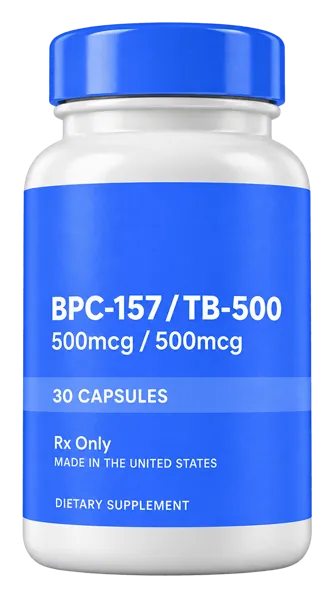
People stack them because the proposed mechanisms look complementary on paper. BPC-157 is studied mainly for blood-vessel growth and for tendon fibroblast activity, while TB-500’s parent protein is studied mainly for actin binding, cell migration and dampening inflammation, so the reasoning in recovery circles is that one helps build the repair site and the other helps cells move into it. That logic is a hypothesis built from separate animal and cell studies of each peptide, not a finding about the pair. Combination products are sold both as injectable blends, often called the “Wolverine” stack, and as oral capsules containing both peptides.
Is there any research on BPC-157 and TB-500 together?
Almost none. The only human data on the combination that we found is one small retrospective series. In a 2021 study described in the 2025 Regeneration or Risk? review, researchers contacted 16 patients who had received knee injections of either BPC-157 alone or BPC-157 combined with thymosin beta-4, and 14 of the 16 reported significant pain relief 6 to 12 months later (McGuire et al., 2025). The reviewers list the study’s limits plainly: a small sample, no control group, and no common diagnosis. It also used the full thymosin beta-4 protein, not the TB-500 fragment, and it cannot separate what the combination did from what BPC-157 alone did. Whether the pair works better than either peptide alone has not been tested in a controlled trial in people or, as far as the reviews cited here report, in animals.
Oral capsules or injectable blends?
The route question is even less studied for the pair than for BPC-157 alone. BPC-157 is unusually stable in gastric juice and was given by mouth in rat studies, which our guide to BPC-157 capsules versus injection covers in detail. For TB-500 there is no equivalent oral research among the studies cited on this page: the thymosin beta-4 work above used injections in animals and eye drops in people. So an oral BPC-157 and TB-500 capsule rests on the BPC-157 stability argument plus an untested assumption about TB-500, while an injectable blend rests on animal injection studies of each peptide separately. Neither form has human efficacy data for injury recovery.
What do people who stack BPC-157 and TB-500 report?
Online, the pair is treated as a default recovery stack. Our July 2026 snapshots of public posts on X about TB-500 (16 posts in each of two samples) found many users describing TB-500 and BPC-157 as a paired stack, with TB-500 cast as the recovery component and BPC-157 as the tissue-repair one, and several describing a return to training after a torn pectoral ligament, a rotator cuff tear or a fractured humerus while using peptide protocols. A skeptical minority said they had stopped buying the combined product and preferred BPC-157 alone, or were not convinced the TB-500 half did anything for them. Another recurring point was technical: some users said products labeled TB-500 often contain the full thymosin beta-4 chain rather than the fragment. These are individual, unverified accounts, often mixing several substances, so they show how people use the stack rather than whether it works.
Are BPC-157 and TB-500 allowed in sport?
No. BPC-157 is “prohibited under the S0 Unapproved Substances category” of the WADA Prohibited List, in and out of competition, per USADA. TB-500, as a thymosin beta-4 peptide, is likewise prohibited at all times under the WADA framework, per the BSCG analysis. A blend of the two contains two prohibited substances. Any athlete tested by WADA, USADA, the NCAA, or a WADA-compliant body cannot use either one without risking a sanction, and as USADA warns, “athletes are advised to never use a product that is marketed for ‘research only.’” Our guide to whether recovery peptides are banned in sport covers the rules in more depth. PeptideAgent’s BPC-157 vs TB-500 comparison reaches a similar verdict from the regulatory side: it finds the two tied on evidence grade, compounding status and WADA status.
Which is better for injury recovery, BPC-157 or TB-500?
There is no evidence-based way to call one “better” than the other for injury recovery, because neither has been tested head-to-head in people and both rest on preclinical data. That is the honest headline, and it reframes the real decision. The choice that most affects your safety is not BPC-157 versus TB-500; it is a supervised plan with a known product versus an unverified vial bought on the research-chemical market, where you cannot confirm what the vial actually contains. In one forensic analysis of 36 seized peptide- and protein-based products, only 15 contained a prohibited substance at all, 12 contained a different, non-prohibited substance, and 9 contained no peptide or protein whatsoever, what a gray-market label promises is routinely not what is in the vial. If your goal is to get a tendon, muscle, or joint healthy again, the more useful next step is to bring that goal to a licensed provider who can weigh the options with the strongest evidence for your injury, which may be structured rehabilitation, an established treatment, or watchful management, depending on the injury. A provider may well recommend something other than the peptide in the headline, and that is the point of clinical supervision. Before you evaluate any source or claim, our tendon-recovery evidence explainer turns everything on this page into questions you can actually ask.
BPC-157 and TB-500 status: Not FDA-approved; sold by some telehealth providers as a compounded prescription. An FDA advisory committee reportedly voted in July 2026 to recommend allowing pharmacies to compound it; nothing has changed yet. How peptide status works.
Educational information only, not medical advice. Scientific and anti-doping statements are sourced to the USADA, BSCG and peer-reviewed documents linked above, checked as of October 12, 2026.
Sources (8)
Advertising disclosure: links marked "Paid link" go to Bodybuilding Peptides (trybbpeptides.com), an affiliate destination, and The Recovery Dose may earn a commission if you buy there. Our coverage is independent of that relationship, and nothing on this page is medical or legal advice.
 See it at Bodybuilding Peptides