What is the Wolverine peptide stack?
The short answer
The Wolverine stack is BPC-157 and TB-500 taken together, usually as one injectable blend, on the theory that the two recovery peptides complement each other. The evidence for each is mostly animal and cell studies. The one controlled study of the pair we found, in rats, saw no added benefit over either peptide alone.
“Wolverine” is the nickname lifters gave to the most hyped recovery combo online: BPC-157 and TB-500 used together, named after the comic-book character who shrugs off injuries. The name does a lot of marketing work. Behind it sit two research peptides whose supporting evidence comes mostly from rats and cell cultures, a single small human chart review that touched the combination, and a 2026 controlled rat study that tested the pair against each peptide alone. This explainer covers what is in the stack, why people pair the two, what the research shows for each and for the combination, side effects, how it compares with other blends, what it costs, and how the community’s stories line up against the studies.
What is the Wolverine stack?
The Wolverine stack is BPC-157 and TB-500 used at the same time for injury recovery, most often bought as a single premixed injectable vial sold as a “Wolverine blend.” BPC-157 is a synthetic 15-amino-acid peptide derived from a protein in gastric juice (McGuire et al., 2025). TB-500 is a synthetic seven-amino-acid fragment (Ac-LKKTETQ) of thymosin beta-4, a natural, widely distributed 43-amino-acid peptide (McGuire et al., 2026); a Belgian anti-doping laboratory identified that fragment in a product sold as TB-500 (Esposito et al., 2012). Neither one is an approved medicine, and the stack is a community invention rather than a formulation that came out of a drug-development program.
What is in a Wolverine blend?
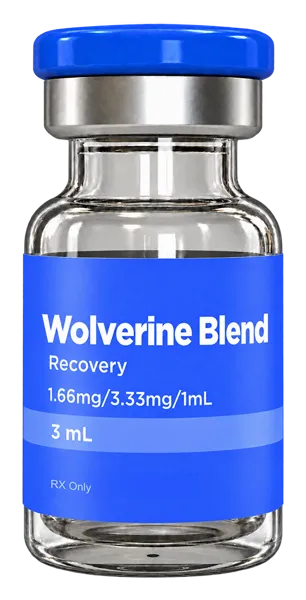
A Wolverine blend contains the same two ingredients in one vial, with the ratio set by the seller rather than by any study. As one example, the Wolverine Blend listed by Bodybuilding Peptides (trybbpeptides.com) on October 12, 2026 was described as an injectable 3 mL vial containing 1.66 mg of BPC-157 and 3.33 mg of TB-500 per mL. Other sellers use other ratios, and there is no research basis for choosing one ratio over another, because no published study has compared ratios. The same idea also shows up in other formats: oral capsules that pair the two peptides, and a three-way “Glow” blend that adds GHK-Cu. The comparison section below lays those out.
Why do lifters pair BPC-157 with TB-500?
Lifters pair them because each peptide has its own pile of encouraging animal studies, and the hope is that two repair signals add up to faster recovery than one. BPC-157 is studied mainly for promoting new blood-vessel growth and the activity of fibroblasts, the cells that lay down collagen in tendons and ligaments (McGuire et al., 2025). Thymosin beta-4, the parent protein of TB-500, is linked to blood-vessel growth and cell proliferation and to curbing inflammation and cell death (McGuire et al., 2026). The usual pitch in gyms and on social media is that one peptide rebuilds the repair site while the other speeds the cells into it. Look closely and the two mechanisms overlap more than the pitch suggests, since both are tied to blood-vessel growth. The synergy idea is a hypothesis assembled from separate studies of each peptide, not a finding about the pair, and the one animal study we found that tested it directly did not support it (see below).
People reach for the stack for the usual lifting injuries: tendon pain, strained or torn muscles, cranky shoulders and elbows, and post-surgery rehab. For a fuller picture of how BPC-157 and TB-500 differ on their own, see our BPC-157 and TB-500 comparison.
What does the research show for BPC-157?
For BPC-157 the evidence is mostly animal and cell studies, plus three very small human studies, none of them a controlled trial for a sports injury. The best-known animal work is from a Zagreb group: in rats with a surgically cut Achilles tendon, daily BPC-157 improved load to failure, walking-function scores and the look of the healing tissue over 14 days compared with saline (Staresinic et al., 2003). The same group linked the effect to better-organized blood-vessel growth, finding no direct blood-vessel effect in cell culture but higher VEGF expression in healing rat muscle and tendon (Brcic et al., 2009).
The human record is thin. A 2025 review counted three published human studies: a knee-injection chart review, a 12-person bladder study, and a two-person intravenous safety test, and it noted that all of them reported positive results, “suggesting a possible publication bias toward positive findings” (McGuire et al., 2025). The reviewers concluded that until well-designed human trials exist, BPC-157 should not be recommended for clinical use in musculoskeletal medicine.
What does the research show for TB-500?
For TB-500 the evidence is weaker still, because almost all of it is about thymosin beta-4, the full protein, not the TB-500 fragment people actually inject. A 2026 scoping review that searched PubMed, Europe PMC and ClinicalTrials.gov found 80 relevant studies; most evaluated thymosin beta-4 rather than TB-500, direct evidence for TB-500 came from a single study, and tendon, ligament and muscle work was “comparatively sparse” (McGuire et al., 2026). The human studies it found sat mostly in eye and skin-wound settings. One example is a phase 2 trial of topical thymosin beta-4 on venous leg ulcers in 73 patients, where safety was comparable to placebo and the authors reported a possible speed-up in healing at one dose (Guarnera et al., 2010). None of that is a test of an injected fragment in an injured lifter. Our TB-500 research explainer walks through those studies in detail.
Has anyone studied BPC-157 and TB-500 together?
In the research we found, only twice, and neither study shows that the combination beats a single peptide. The most direct test is a 2026 rat study from Turkey: 32 rats had their Achilles tendons cut and repaired, then received saline, BPC-157, TB-500, or both, by injection into the abdomen for four weeks (Biçer et al., 2026). TB-500 alone produced significantly better tendon-tissue scores than controls and was the only group with a statistically significant gain in the force the tendon could take before failing; BPC-157 alone scored better than controls numerically, but its total scores did not reach significance. The combination group beat controls on one of the two tissue-scoring scales. The authors’ headline finding for the stack was plain: “Combined BPC-157 and TB-500 treatment did not confer additional benefits compared to either agent alone.” They called the study exploratory, and it was eight rats per group.
The only human data comes from a retrospective chart review at a Florida clinic. Of 16 people with knee pain who were reached by phone, most of them 6 to 12 months after knee injections, 12 had received BPC-157 alone and 4 had received BPC-157 plus thymosin beta-4; 11 of the 12 and 3 of the 4 reported significant improvement (Lee and Padgett, 2021). There was no control group, no standard outcome measure and no common diagnosis, the combination arm was four people, and the second peptide is reported as thymosin beta-4 (TB4), not TB-500. It cannot tell you whether adding the second peptide did anything.
BPC-157, TB-500 and the Wolverine stack side by side
The table puts the two ingredients and the combination on the same rows. The evidence level is the row that matters most, and it is low for all three columns.
| Attribute | BPC-157 | TB-500 | Wolverine stack (both) |
|---|---|---|---|
| What it is | Synthetic 15-amino-acid peptide from a gastric protein | Synthetic 7-amino-acid fragment of thymosin beta-4 | Both peptides together, usually one premixed vial |
| Main proposed action | Blood-vessel growth and fibroblast activity | Blood-vessel growth, cell proliferation, less inflammation (parent protein) | Assumed to add up; the two actions overlap |
| Evidence level | Mostly animal and cell studies; three tiny human studies | Mostly animal and cell studies of the parent protein; one direct TB-500 study | One rat study and one 4-person subgroup in a chart review |
| Controlled human trial for a sports injury | No | No | No |
| Did the combination beat single peptides? | Not applicable | Not applicable | No, in the one rat study we found that tested it |
What are the side effects of the Wolverine stack?
Nobody knows the side-effect profile of the combination, because no study has measured it in people. For BPC-157, the three small human studies reported no adverse effects, and in a two-person safety test, intravenous infusions of up to 20 mg caused no measurable changes in heart, liver, kidney, thyroid or blood-sugar markers (Lee and Burgess, 2025). Two people over two days says almost nothing about months of use. The 2025 review also lists theoretical concerns, chiefly unwanted blood-vessel growth, which matters in tumor biology, and nitric-oxide overproduction, while noting studies that point the other way (McGuire et al., 2025); our BPC-157 side effects guide covers those in more depth. A 2026 review in Missouri Medicine groups BPC-157 and TB-500 with unregulated injectables that lack established human safety profiles and lists contamination, inaccurate dosing, pathological blood-vessel growth and cancer risk among the potential hazards (Moiz et al., 2026).
The second risk is what is in the vial. A French horse-racing laboratory that analyzed products sold online as TB500 and TB1000 found their contents were “not systematically consistent” with how they were described (Delcourt et al., 2023), and a Danish forensic lab testing 36 seized peptide and protein products found 9 that contained no peptide or protein at all (Høj et al., 2021). People who should be especially cautious include anyone with a history of cancer, given the blood-vessel question; anyone pregnant or breastfeeding, since there is no human data; and athletes in tested sports.
How does the Wolverine blend compare with other BPC-157 and TB-500 options?
The Wolverine blend is one of four common ways people get these peptides, and none of the four has better human evidence than the others. Single-peptide vials let people use one at a time; in the 2026 rat study, the pair did no better than either peptide given alone. Oral capsules raise a separate question, whether the peptides survive digestion, which our guide to BPC-157 capsules versus injection covers; none of the studies cited on this page tested oral TB-500. The Glow blend adds GHK-Cu, a copper peptide best known from skin care, which this page does not review. For a broader view of every peptide marketed for healing, see our guide to peptides for injury recovery. PeptideAgent’s Wolverine stack profile lands in the same place on the combination: it lists no published study of the blend and grades each ingredient on its own.
| Attribute | Wolverine Blend | BPC-157 / TB-500 capsules | BPC-157 or TB-500 alone | Glow Blend |
|---|---|---|---|---|
| Form and listed strength | Injectable, 3 mL vial; 1.66 mg BPC-157 and 3.33 mg TB-500 per mL | Oral capsule; 500 mcg BPC-157 and 500 mcg TB-500 | BPC-157: injectable, 3 mg/mL, 5 mL vial. TB-500: injectable, 10 mg / 3 mL vial | Injectable, 3 mL vial; GHK-Cu 9 mg, BPC-157 1.66 mg, TB-500 3.33 mg per mL |
| Listed price per month | $220 (1-month plan) or $180 (3-month plan) | $242 (1-month plan) or $187 (3-month plan) | BPC-157 $199; TB-500 $220 (1-month plan) | $353 (1-month plan) |
| Studied as this exact product | No | No | No | No |
| Closest research | One rat tendon study of the pair | See our capsules guide for oral BPC-157; no oral TB-500 studies cited here | Animal studies of each peptide; tiny human studies of BPC-157 | Same as Wolverine for its BPC-157 and TB-500 content |
How much does a Wolverine blend cost?
At Bodybuilding Peptides, the store whose card appears on this page, the Wolverine Blend was listed on October 12, 2026 at $220 a month on a one-month plan or $180 a month on a three-month plan. The two peptides as separate injectable vials from the same store were listed at $199 a month for BPC-157 and $220 a month for TB-500, though the vials hold different amounts than the blend, so the prices do not compare like for like. No study has compared these products, and a higher price says nothing about the evidence. Checkout prices were not re-verified on that date, so treat the listing as a guide, not a quote.
What are lifters saying about the Wolverine stack?
In public posts, BPC-157 and TB-500 are treated as the default recovery pair, and the stories run well ahead of the studies. Our July 2026 snapshots of public posts on X (16 posts about TB-500 and 16 about BPC-157 on therecoverydose, collected July 14 to 20) found users and peptide accounts describing the two as a paired stack, with TB-500 cast as the recovery peptide and BPC-157 as the tissue-repair one. Several described getting back to training after a torn pectoral ligament or a torn rotator cuff while on a peptide protocol, often alongside other substances, and one described using both after a fracture and surgical repair. A skeptical minority said they had stopped buying the combined product, preferred BPC-157 alone for soreness, or were unsold on the pairing. Others argued that products labeled TB-500 often contain the full thymosin beta-4 chain instead of the fragment. On safety, one poster said they had compiled adverse-event reports, flagged a possible cancer signal and tied it to the VEGF blood-vessel pathway, while another called BPC-157 cheap and very safe. These are individual, unverified accounts. For the running summary of what people say about BPC-157, see the community section of The Treatment Report’s BPC-157 page.
What lifters say vs what studies show
The community and the research agree on what people use the stack for and disagree on almost everything about whether it works. This is the gap in one table.
| Attribute | What lifters say | What studies show |
|---|---|---|
| Two peptides beat one | The stack covers more of the repair process than either peptide | In the only controlled test (rats), the pair added no benefit over either alone |
| It got me back to training | Return to lifting after pectoral ligament or rotator cuff tears | No controlled human trial in sports injuries; one uncontrolled 16-person knee chart review |
| TB-500 is the recovery half | TB-500 is the go-to recovery peptide | Direct TB-500 evidence is one study; most data are on the full thymosin beta-4 protein |
| It is very safe | Some say very safe; others flag a possible cancer signal | Human safety data cover a few people over short periods; long-term effects are unstudied |
| The label is what is inside | Some warn TB-500 products often hold full-chain thymosin beta-4 | Lab testing of online TB500 products found contents not always consistent with how they were described |
What can Wolverine stack before and after stories tell you?
Before and after stories show what people experienced, not what the peptides did, because a healing injury improves over time on its own and people rarely change only one thing. A lifter who starts the stack at the worst point of a tendon flare-up, rests, rehabs and returns to training weeks later has a real recovery story but no way to separate the peptide from time, rehab and rest. A 2026 review in Sports Medicine on peptides in musculoskeletal care discusses the placebo effect as a mediator of peptide efficacy and how social media amplifies it (Mendias and Awan, 2026). That is why this page does not use before and after photos: they cannot carry the weight that posts put on them.
Is the Wolverine stack worth the hype?
On the evidence, the hype is ahead of the science. Each peptide has a plausible mechanism and a stack of encouraging animal studies, but neither has a controlled human trial in a sports injury, and the one animal study we found that tested the combination found two peptides did no better than one. If the stack’s main selling point is synergy, that is the claim with the least support. Anyone weighing it for an injury gets more from a diagnosis and a structured rehab plan, and from asking a clinician what the evidence shows for that specific injury, than from the nickname.
BPC-157 and TB-500 status: Not FDA-approved; sold by some telehealth providers as a compounded prescription. An FDA advisory committee reportedly voted in July 2026 to recommend allowing pharmacies to compound it; nothing has changed yet. How peptide status works.
Educational information only, not medical advice. Research statements are sourced to the peer-reviewed papers linked above, checked as of October 12, 2026.
Sources (13)
Advertising disclosure: links marked "Paid link" go to Bodybuilding Peptides (trybbpeptides.com), an affiliate destination, and The Recovery Dose may earn a commission if you buy there. Our coverage is independent of that relationship, and nothing on this page is medical or legal advice.
 See it at Bodybuilding Peptides