What do Wolverine stack before and after stories actually show?

The short answer
Wolverine stack before and after stories show what people experienced, not what BPC-157 and TB-500 did. No human trial has tested the pair or timed how long it takes to work. The healing windows you see quoted come from rat studies that examined tendons and ligaments at set points, from 14 days to 90 days, and the one rat study of the pair found no added benefit over either peptide alone.
Key takeaways
- Before and after stories show what one person experienced, not what BPC-157 and TB-500 did, because they have no comparison group.
- No human trial has tested the pair or timed how long it takes to work, and none was registered as of October 17, 2026.
- The healing windows quoted online come from rat studies that examined tendons and ligaments on set days, from 14 to 90 days after injury.
- The one rat study of the pair found the combination added no benefit over either peptide alone.
- Some people report no change, and online stories lean toward successes, a tilt reviewers also see in the published BPC-157 studies.
Search “Wolverine stack before and after” and you find recovery stories, week counts and confident timelines. This page sets those stories next to what research actually measured. The Wolverine stack is BPC-157 and TB-500 used together, and the gap between what people report and what anyone has timed is wide: no human trial has tested the pair, and the only timed healing windows in the research come from rat studies. Below: what people who pair the two peptides say, why those stories cannot carry much weight, what the animal studies timed, and why some people notice nothing at all.
What do Wolverine stack before and after stories actually show?
They show a person’s experience over a stretch of time, not the effect of the peptides. A before and after story has no comparison group, so it cannot separate BPC-157 and TB-500 from rest, rehab, other substances, placebo and the ordinary course of healing. The research that could answer the question does not exist yet: a ClinicalTrials.gov search we ran on October 17, 2026 found no registered trial of BPC-157 and TB-500 together. The one controlled study of the pair was in rats, and it found that “Combined BPC-157 and TB-500 treatment did not confer additional benefits compared to either agent alone” (Biçer et al., 2026).
What do people who pair BPC-157 and TB-500 report?
In our July 2026 snapshots of public posts on X (16 posts about TB-500 and 16 about BPC-157, collected July 14 to 20), people described returning to training after injuries while using the two peptides together. The reports are self-described and unverified. The snapshot summaries do not use the name “Wolverine”, so this section describes people who pair BPC-157 with TB-500 rather than a named product.
| What people described | What the snapshot summary notes |
|---|---|
| Getting back to weight training after a torn pectoral ligament or a torn rotator cuff | Individual anecdotes, often while using other substances at the same time |
| Feeling healed within weeks of starting a peptide protocol | A personal impression of timing, with no measurement behind it |
| Using both peptides after a fracture and surgical repair | A self-described protocol, not evidence of effect |
| Starting tendon rehab and wanting to add the peptides | A plan, not a result |
| Stopping the combined product and preferring BPC-157 alone for soreness | A skeptical minority, unconvinced by the pairing |
The mood in the TB-500 sample was mixed. The summary scored about four in ten posts as positive and three in ten as skeptical, and it labels those proportions an anecdotal, non-scientific snapshot rather than evidence. Our community pages for BPC-157 and TB-500 show the full themes, the original posts and two hand-picked Reddit threads about using the pair. The sections further down this page set each theme against the studies.
Why are before and after stories weak evidence?
Before and after stories are weak evidence because almost everything that changes between the “before” and the “after” is something other than the peptide. Four problems show up in nearly every account:
- Time heals on its own. Many soft-tissue injuries improve with time, rest and rehab. A story that spans a normal healing period cannot show the healing was faster than it would have been.
- People change several things at once. The posts in our snapshot often describe the peptides alongside other substances, and some alongside tendon rehab. There is no way to credit one part of that mix.
- Nobody checked the product. Some posters themselves warned that products labeled TB-500 may hold the full thymosin beta-4 protein rather than the short fragment, so even the user may not know what they took.
- Expectation shapes how people feel. A 2026 review in Sports Medicine discusses the placebo effect as a mediator of peptide efficacy and how social media amplifies it (Mendias and Awan, 2026).
Even published case reports run into the same wall. In three cases of jaw nerve injury after dental procedures, treated with BPC-157, TB-500, a third peptide and other drugs, the authors wrote that because the observations were uncontrolled, “spontaneous recovery and other confounding factors cannot be excluded” (Froum et al., 2026). That is the same limit every forum before and after carries, stated by the people who wrote it up.
What healing windows did the animal studies measure?
The animal studies examined injured rat tendons and ligaments at fixed points after the injury, from 14 days up to 90 days. Each one is a rat study, and each measured healing tissue, not how a person felt.
| Study | Animal and injury | When healing was measured | What was found |
|---|---|---|---|
| Staresinic et al., 2003 | Rat, cut Achilles tendon, BPC-157 | Days 1, 4, 7, 10 and 14 | Better load to failure, walking-function scores and tissue appearance than saline |
| Krivic et al., 2006 | Rat, Achilles tendon detached from bone, BPC-157 | Days 1, 4, 7, 10, 14 and 21 | Better function, strength and collagen organization; also offset a steroid’s slowing of healing |
| Cerovecki et al., 2010 | Rat, cut knee ligament (MCL), BPC-157 | Throughout 90 days | Functional, biomechanical and tissue improvements by injection, by mouth and as a cream |
| Biçer et al., 2026 | Rat, cut and repaired Achilles tendon, BPC-157, TB-500 or both | At four weeks | TB-500 alone gave the clearest gains; the pair added nothing over either peptide alone |
A 2025 review of the BPC-157 research adds that in one tendon study, biomechanical improvements persisted through a 21 to 72 day observation period, and that the processes the peptide sets off in animals appear to last far longer than the peptide itself stays in the body, which the review puts at a half-life of under 30 minutes (McGuire et al., 2025).
Note what the table cannot tell you: when a rat in these studies “got better”, it was judged by a researcher measuring tendon strength or tissue under a microscope on a set day, not by the rat returning to normal activity.
Why is a rat healing window not a human timeline?
A rat healing window is a study design, not a forecast. The researchers chose when to look, and those days were picked to suit a rat. Rats differ from people in size, metabolism and how fast their tissues turn over. A surgically cut tendon in a young lab rat is not the same injury as a lifter’s long-running tendon pain or a partial tear. The lab peptide was also a verified compound given in a controlled way, which a person buying a product online cannot assume.
Crossing those gaps is the job of a human trial, and for this pair no such trial has been published.
USADA says plainly that there are “no human clinical trials establishing efficacy” for BPC-157 for any diagnosis or treatment (USADA).
How long does the Wolverine stack take to work?
Nobody knows, because no study has timed it in people. The week ranges on clinic, vendor and forum pages are not sourced to a human trial, because there is none for the pair. The closest human data is a retrospective chart review of knee injections, where four people received BPC-157 plus thymosin beta-4.
Most patients were contacted 6 months to a year after their injection, and no standard outcome tools were used, so it says nothing about how fast anything happened (Lee and Padgett, 2021). Our page on how long BPC-157 takes to work covers the single-peptide version of this question in more depth.
| Where a timeline comes from | What it measured | What it tells you about a person |
|---|---|---|
| Forum and social posts | One person’s impression, often with other substances, product unverified | Nothing reliable about speed |
| Rat tendon and ligament studies | Tissue strength and structure on set days, 14 to 90 days after injury | That treated rats healed better in that window, not how fast you will |
| Knee chart review (16 people, 4 on both peptides) | Self-rated pain recalled months later, no control | Nothing about timing |
| Human trials of the pair | None registered or published as of October 17, 2026 | No answer exists yet |
Why do some people report no change?
Some people report no change because there may be little or nothing to notice, and the stories online lean toward successes. In our TB-500 snapshot, a skeptical minority said they had stopped buying the combined product, preferred BPC-157 alone or were simply unsold on the pairing. In the only human data touching the pair, one of the four knee patients on both peptides reported no relief (Lee and Padgett, 2021). Several plausible reasons apply, none of which has been tested for this stack:
- The effect may be small or absent in people. Animal results often do not carry over to humans, and the pair has never been tested in people.
- The product may not match the label. If the vial does not contain what it says, there is nothing to respond to.
- The injury may not be the kind studied. The rat studies used fresh, surgically cut tendons and ligaments, not long-running pain or degeneration.
- Positive stories get posted more. Reviewers of BPC-157 note that all the published studies report positive or beneficial effects, which they read as a possible publication bias toward positive findings (McGuire et al., 2025). Forum posts have the same tilt.
Who is skeptical of the Wolverine stack, and why?
A skeptical minority says the pair did not earn its place.
In our TB-500 snapshot, a few people said they stopped buying the combined product and favored BPC-157 alone because it seemed to do more for their soreness. Another listed other peptides they felt had worked for them and said they remained unsold on the BPC-157 and TB-500 pairing. The summary scored about three in ten TB-500 posts as skeptical, four in ten as positive, two in ten as mixed and one in ten as negative.
The research neither backs nor refutes those preferences, because nobody has compared the two in people. The rat study cuts the other way from the posters: TB-500 alone gave the clearest results, including the only significant gain in tendon strength, while BPC-157 alone improved tissue scores only numerically, without reaching significance on the total scores (Biçer et al., 2026). But that study measured repaired rat tendons at four weeks, not soreness in people, so it cannot settle what a lifter felt. Our page on whether the Wolverine stack works sets out the full study record.
The wider expert view is skeptical of the whole category: a 2026 UCLA scoping review in the American Journal of Sports Medicine concluded that the claimed recovery benefits of these peptides “remain unsubstantiated by current human trials” (Tewari et al., 2026).
What do people say about getting a different peptide than the label says?
Some posters warn that the TB-500 label is used loosely, and that products sold as TB-500 often contain the full thymosin beta-4 protein rather than the short fragment the name refers to. They raise it as something that changes what a buyer is actually taking. This is one of the few community claims that lines up, at least in part, with published lab work.
| Question | What the evidence shows | Source |
|---|---|---|
| What is TB-500 supposed to be? | An anti-doping lab identified a short acetylated fragment of thymosin beta-4 (amino acids 17 to 23) in a product called TB-500 | Esposito et al., 2012, lab analysis |
| How does FDA name it? | ”Thymosin beta-4, fragment (LKKTETQ), also known as TB-500” | FDA bulk substances page |
| Do sold products match their labels? | Lab analysis of TB500 and TB1000 products sold online found contents “not systematically consistent” with their descriptions | Delcourt et al., 2023, lab analysis |
| Which form was studied? | Most studies tested full-length thymosin beta-4, not TB-500; the review found direct TB-500 evidence limited to a single study | McGuire et al., 2026, scoping review |
So the posters are right that the label is a weak guide, but the word “often” is theirs. No study we found has measured how often products labeled TB-500 hold the full protein instead of the fragment.
The practical point stands either way: a person cannot know which molecule, at what purity, they received, and the research they may be leaning on probably used a different one. Our TB-500 research explainer covers the fragment and full-protein difference in more depth.
How split are lifters on safety?
Views split sharply. In our BPC-157 snapshot, one poster described compiling self-reported adverse events and flagged what they saw as a possible cancer signal tied to VEGF, a blood-vessel growth factor, while cautioning that nobody knows how many people use the peptide. Another poster called BPC-157 cheap and very safe. The snapshot summary says plainly that commenters do not agree on the risk profile.
Neither side has human data to stand on, because safety of the pair has never been measured in people. Here is what each side can point to:
| Claim | What the research shows | Type of evidence |
|---|---|---|
| BPC-157 is low risk | Animal toxicology in mice, rats, rabbits and dogs found no serious toxicity (Xu et al., 2020); three small human pilot studies reported no adverse effects (McGuire et al., 2025) | Animal; small uncontrolled human |
| The blood-vessel pathway is a worry | BPC-157 increased blood-vessel growth, linked to the VEGFR2 receptor, in chick embryo, rat and cell experiments (Hsieh et al., 2017); a 2026 review lists pathological blood-vessel growth and cancer among potential risks of these unregulated peptides (Moiz et al., 2026) | Animal and cell; review of potential risks, not observed cases |
| Nobody knows about TB-500 in people | FDA says it has not identified any human exposure data for the TB-500 fragment (FDA) | Regulator |
| The pair together | Not studied for safety in people at all | No data |
The cancer concern is a theoretical one drawn from mechanism, and the “very safe” view rests on animal tests and a handful of tiny human studies. A self-compiled list of adverse events cannot show cause, and a short run of animal toxicology cannot rule out rare or long-term harm.
USADA notes there are “no human clinical trials establishing efficacy” for BPC-157 for any use (USADA). Our page on whether the Wolverine stack is safe goes through the recorded and unmeasured side effects in detail.
Where can you read the original posts?
Our community pages show the themes, the original public posts and the two hand-picked Reddit threads. The page for BPC-157 covers the recovery, safety and pairing themes, and the page for TB-500 carries the label-identity and skeptic themes along with two Reddit threads from r/ACL and r/Biohackers about using the pair. We link to posts rather than quoting them at length, and we screen out threads about dose amounts or where to buy. For the research on each peptide alone, see the overviews of BPC-157 and TB-500 on our sister site.
What would a real before and after test look like?
A real test would compare people who got the peptides with similar people who did not, assigned by chance, with healing measured the same way on the same days. That is how two single-peptide BPC-157 trials are set up on ClinicalTrials.gov: one for acute hamstring strains, which compares BPC-157 with a placebo and was listed as recruiting on October 17, 2026 (NCT07437547), and one after rotator cuff repair surgery, which compares it with a sham and was not yet recruiting (NCT07803250). Neither has results, and neither tests TB-500 or the pair.
Our page on the Wolverine stack after surgery covers the rotator cuff trial and the other surgical studies. Until a trial like that reports, the honest reading of any Wolverine stack before and after is “this is what happened to one person”, not “this is what the stack does”.
For what is known about side effects of the pair, see is the Wolverine stack safe?, and for what TB-500 itself has been tested for, see our TB-500 research explainer.
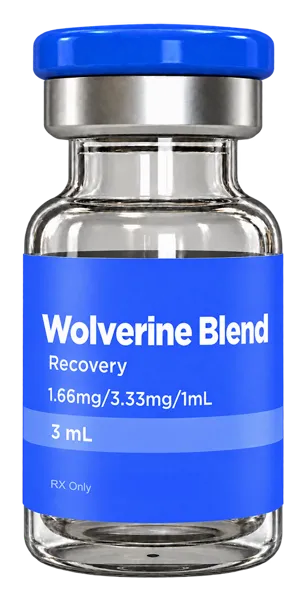
BPC-157, TB-500 and Wolverine blend status: BPC-157: Not FDA-approved. Under a draft HHS policy filed Oct 28, 2026, HHS does not intend to act against licensed compounding of it alone, under strict conditions: injection, oral or topical. TB-500: Not FDA-approved. Under a draft HHS policy filed Oct 28, 2026, HHS does not intend to act against licensed compounding of it alone, under strict conditions: injection only. Wolverine blend (BPC-157 + TB-500): Not FDA-approved. The draft HHS policy filed Oct 28, 2026 covers single-ingredient products only, so this two-peptide blend is not covered. How peptide status works.
Educational information only, not medical advice. Research statements are sourced to the papers and registry records linked above, checked as of October 17, 2026. Study observation periods are reported as what the research measured, not as expectations or recommendations.
Frequently asked questions
What do Wolverine stack before and after reports show?
They show a person's experience over a stretch of time, not the peptides' effect. Each story mixes the peptides with rest, rehab, other substances, expectation and the normal course of healing, and the product itself is usually unverified. Even published case reports carry the same limit: in three dental nerve cases, the authors wrote that spontaneous recovery and other confounding factors cannot be excluded.
What do people on Reddit say about the Wolverine stack?
Public posts mostly describe BPC-157 and TB-500 as a recovery pair, with stories of getting back to training after an injury. A skeptical minority says they stopped buying the combined product or prefer BPC-157 alone, some warn that products labeled TB-500 may not hold the fragment, and views on safety are split. Our community pages for BPC-157 and TB-500 link two hand-picked Reddit threads; all of it is anecdote, not evidence.
How long does the Wolverine stack take to work?
No study has timed it in people, and no human trial has tested the pair at all. The rat tendon and ligament studies examined healing on days the researchers chose, from 14 to 90 days after injury, which is a study design rather than a human forecast. Our page on how long BPC-157 takes to work covers the single-peptide question in depth.
Does the Wolverine stack work?
That has not been shown. No human trial of BPC-157 and TB-500 together has been published, and the one controlled study of the pair, in rats with repaired Achilles tendons, found the combination did not confer additional benefits over either peptide alone. Our page on whether the Wolverine stack works labels every study animal or human.
Sources (19)
About the editorial team
Advertising disclosure: links marked "Paid link" go to Bodybuilding Peptides (trybbpeptides.com), an affiliate destination, and The Recovery Dose may earn a commission if you buy there. Our coverage is independent of that relationship, and nothing on this page is medical or legal advice.
 See it at Bodybuilding Peptides